
Best Cable Cutting Machine for Heat Shrink Tubing and Wires — Precision on a Budget
Your production line cuts 600 pieces of heat shrink tubing per shift. Each piece needs to be exactly 47 mm long — because after heating, the tubing will shrink 5–15% in length. If your cutting machine adds another ±2 mm of error on top of that, your finished pieces end up too short. Exposed wire. Failed insulation. Rework.
This is not a theoretical problem. It happens every day in harness assembly, switchgear production, and cable preparation workshops that rely on manual cutting or low-precision machines.
The fix is straightforward: a cable cutting machine with ±0.1 mm tolerance, a guillotine blade that does not deform the tubing, and a stepper motor that feeds the material at a consistent, programmable length. No full-automation price tag required.
This guide covers what to look for in a cutting machine when your materials include heat shrink tubing, PVC sleeving, silicone tubes, and wires up to 35 mm² — and how to choose the right model without overpaying.
Key Takeaways
- Heat shrink tubing shrinks 5–15% in length after heating — your cut length must compensate for this, which means cutting accuracy matters more than with rigid materials.
- Industry-standard cutting tolerances for heat shrink tubing range from ±1.5 mm to ±4 mm depending on length. A machine with ±0.1 mm accuracy eliminates the cutting variable entirely.
- Guillotine blades produce clean, square cuts on soft and hollow materials without crushing — unlike rotary blades, which can deform thin-wall tubing.
- Stepper motor drives deliver repeatable feed lengths without drift, making them ideal for batch production of identical pieces.
- You do not need a fully automatic wire processing line. A benchtop cutting machine with programmable length and quantity handles heat shrink tubing, PVC sleeving, and wires up to 35 mm² — at a fraction of the cost.
Why Heat Shrink Tubing Is Harder to Cut Than Wire
Wire is rigid. You feed it, the blade goes through, the piece drops. The material does not compress, stretch, or change shape during the cut.
Heat shrink tubing is different. It is a hollow, flexible thermoplastic — usually polyolefin — that deforms under pressure. If the blade squeezes the tube instead of slicing it cleanly, the cut end is oval instead of round. After shrinking, that oval translates into an uneven edge that does not seal properly.
Three properties make heat shrink tubing more demanding to cut than standard wire or cable:
Hollow cross-section. The tube collapses if the blade applies lateral force before cutting through. This is why guillotine-style blades — which apply vertical shearing force — produce cleaner results than rotary cutters on thin-wall tubing.
Longitudinal shrinkage. When heated, the tubing does not only shrink radially (the useful part). It also shortens by 5–15% along its length, depending on the material and shrink ratio. That means a piece cut at 50 mm may end up at 42.5–47.5 mm after recovery. If your cutting machine already added ±2 mm of error, your final length is unpredictable.
Soft, low-friction surface. Standard feed rollers can slip on heat shrink tubing, especially on smaller diameters. A stepper motor with controlled roller pressure ensures the material advances exactly the programmed distance — every time, without drift.
Cutting Tolerance: Industry Standard vs. ±0.1 mm
Manufacturers of heat shrink tubing publish cutting tolerances for their pre-cut products. These numbers show what the industry considers „acceptable.” Compare them to what a precision cutting machine delivers:
| Cut length | Industry tolerance (typical) | LCM machine tolerance | Difference |
|---|---|---|---|
| ≤ 30 mm | ±1.5 mm | ±0.1 mm | 15× more precise |
| 31–100 mm | +4 / −2 mm | ±0.1 mm | 20–40× more precise |
| 101–300 mm | +4 / −2 mm | ±0.1 mm | 20–40× more precise |
| 301–500 mm | +5 / −3 mm | ±0.1 mm | 30–50× more precise |
Industry tolerances based on Qualtek Heat Shrink Tubing Cutting Tolerance specifications for standard polyolefin and fluoropolymer tubing.
The practical takeaway: when you cut heat shrink tubing on a machine with ±0.1 mm accuracy, the only variable left is the material’s own longitudinal shrinkage — and that is a known, compensable property. You account for it once in your program, and every piece comes out right.
Two Features That Define Cut Quality on Flexible Materials
Not every cutting machine handles heat shrink tubing and sleeving well. The two features that separate a machine that works from one that struggles are the blade type and the drive system.
Guillotine blade: clean cuts without crushing
A guillotine blade descends vertically through the material in a single, fast stroke. The shearing force is applied perpendicular to the tube — so the tube does not get squeezed flat before it gets cut. The result is a square, clean edge with minimal deformation.
Rotary blades spin continuously and work well on rigid materials like solid copper wire. But on soft, hollow tubing, the rotating action can drag and deform the material before completing the cut — especially on thin-wall tubing under 3 mm diameter.
For production environments that cut both wires and flexible tubing, a guillotine blade is the more versatile choice. It handles both material types without switching tools.
Stepper motor drive: repeatable length, every piece
A stepper motor moves in discrete, precise steps. When the controller tells it to feed 47.0 mm of material, it feeds exactly 47.0 mm. There is no analog drift, no belt slippage, no gradual length change across a batch.
This matters most when you are cutting hundreds or thousands of identical pieces. A batch of 500 heat shrink sleeves at 47.0 mm ±0.1 mm means you can compensate for longitudinal shrinkage with confidence — because you know the input length is consistent.
The math behind cut length compensation
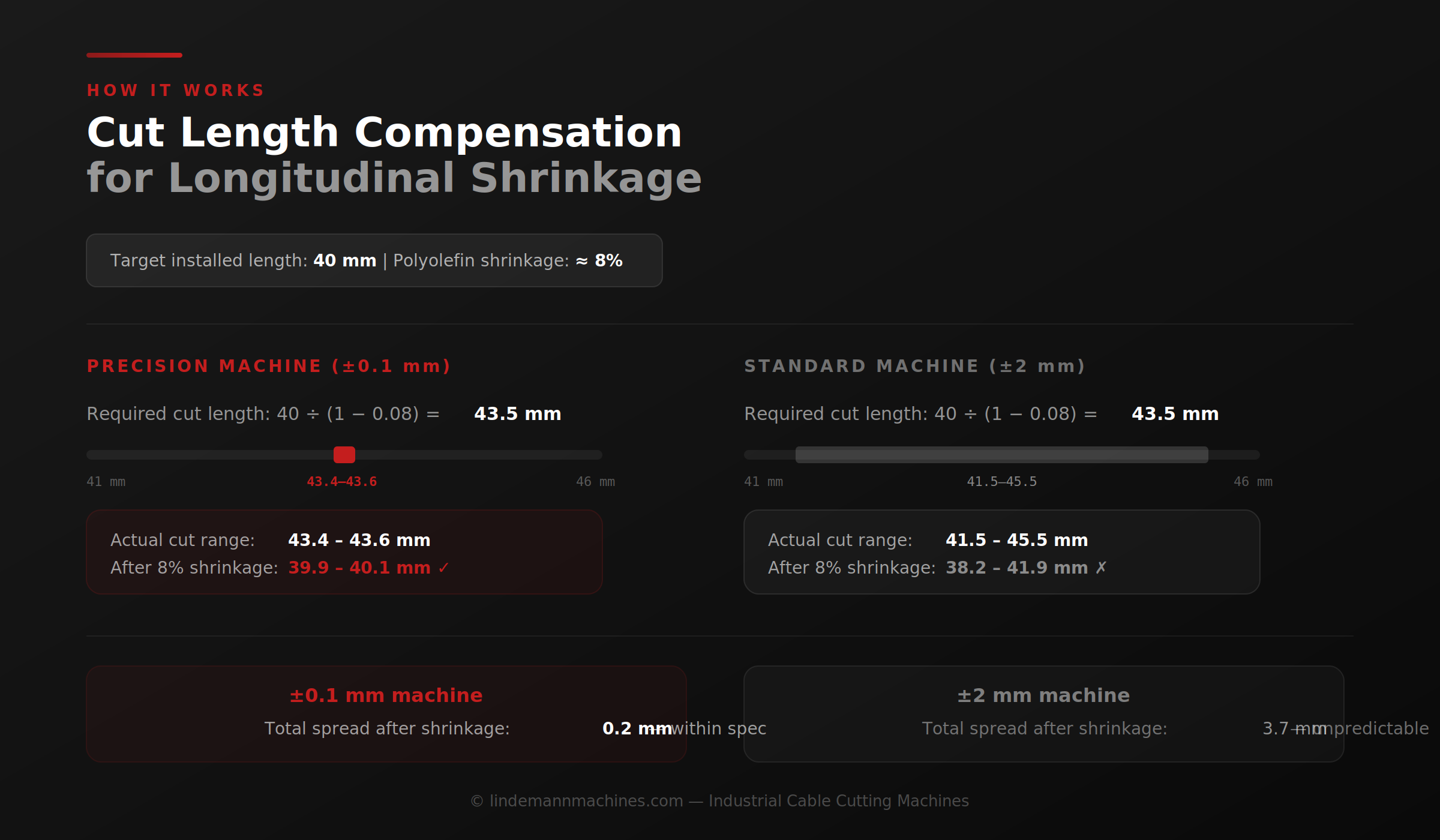
Your target installed length after shrinking: 40 mm
Material: standard polyolefin, longitudinal shrinkage: ≈ 8%
Required cut length: 40 ÷ (1 − 0.08) = 43.5 mm
With a ±0.1 mm machine, your actual pieces will be 43.4–43.6 mm — all within spec.
With a ±2 mm tolerance, your pieces range from 41.5–45.5 mm — a 4 mm spread that makes consistent results impossible.
What Materials Can You Cut on a Single Machine?
A precision cable cutting machine with a guillotine blade is not limited to heat shrink tubing. The same machine handles a wide range of flexible and semi-rigid materials used in cable assembly and electrical production:
Heat shrink tubing
Polyolefin, PVC, fluoropolymer (PTFE/FEP). Single-wall and dual-wall adhesive-lined. All standard shrink ratios (2:1, 3:1, 4:1).
PVC and silicone sleeving
Insulation sleeving, identification tubing, protective conduit. Flexible materials that deform under pressure — guillotine blade handles them without crushing.
Wires and cables
Stranded and solid copper wire, control cables, flat ribbon cable. Cross-sections up to 35 mm² depending on model.
Corrugated tubing and hoses
Fiberglass sleeving, expandable braided sleeving, small-diameter corrugated tubes used in automotive and switchgear wiring.
One machine, one setup. Program the length and quantity, load the material from a spool, press start. No tool changes between materials — the guillotine blade and stepper motor feed handle them all.
Not sure if your material will cut cleanly?
Send us a sample of your heat shrink tubing or sleeving. We will run a free test cut and send you the results — with photos and measurements.
Which Cutting Machine Fits Your Production?
The right machine depends on one thing: the maximum cross-section of the material you need to cut. Heat shrink tubing with a wall thickness under 1 mm is easy — any of the three models below handles it. But if you also cut wires or cables alongside your tubing, the wire cross-section determines which model you need.
All three models share the same core: ±0.1 mm cutting accuracy, stepper motor feed, guillotine blade, programmable length and batch quantity, and 99-program memory. The difference is capacity.
| Model | Max. wire cross-section | Best for | Details |
|---|---|---|---|
| CUTTER B4 | up to 10 mm² | Heat shrink tubing, thin sleeving, small-gauge wires. The go-to for tubing-focused production. | See CUTTER B4 → |
| CUTTER V7 | up to 25 mm² | Mixed production — tubing and medium-gauge cables. Handles thicker insulation materials. | See CUTTER V7 → |
| CUTTER D1 | up to 35 mm² | Heavy cables, thick corrugated tubing, and large-diameter hoses alongside standard heat shrink. | See CUTTER D1 → |
If you only cut heat shrink tubing and wires up to 10 mm², the CUTTER B4 is the most cost-effective option. If your production also includes thicker cables or you want headroom for future materials, the V7 or D1 gives you that capacity without sacrificing precision.
All three machines ship within 7–14 days and include the first year of service and maintenance.
„If your cutting tolerance is ±2 mm and your material shrinks another 8%, you are not cutting — you are guessing.”
You Do Not Need a Full Wire Processing Line
Fully automatic wire processing machines — the kind that cut, strip, crimp, and mark in one pass — cost tens of thousands of euros. They make sense for automotive harness plants running 50,000 pieces per day. If you have been comparing machines from Komax or Schleuniger and wondering whether you need that level of automation, read our detailed comparison of LCM vs. Komax.
But if your production involves cutting heat shrink tubing to length, preparing PVC sleeving, and cutting wires for switchgear assembly or cable harnesses — you do not need that level of automation. What you need is one thing done precisely: cutting to length.
A dedicated benchtop cutting machine with precise digital control of cut length and quantity does exactly that. No stripping head, no crimping station, no marking unit — and no five-figure investment. Just accurate, repeatable cuts on the materials you actually use, at a speed that matches your production without overkill.
The machine is designed for cutting — that single function — and it does it at ±0.1 mm. If you need stripping or crimping, those are separate stations in your workflow. Keeping them separate means each tool is optimized for its job, easier to maintain, and cheaper to replace.
Summary: What Matters When Cutting Heat Shrink Tubing
- Cutting accuracy ±0.1 mm — eliminates the machine as a source of length error. The only remaining variable is the material’s own longitudinal shrinkage, which is known and compensable.
- Guillotine blade — vertical shearing force produces clean, square cuts on hollow and flexible materials without deformation.
- Stepper motor feed — discrete-step positioning delivers identical feed lengths across entire batches. No drift, no slippage.
- Programmable batch production — set length, quantity, and feed speed. Store up to 99 programs for recurring jobs. Switch materials without recalibrating.
- Universal compatibility — one machine cuts heat shrink tubing, PVC sleeving, silicone tubes, wires, cables, and corrugated tubing. No tool changes required.
- Budget-appropriate — a fraction of the cost of full wire processing automation. Purpose-built for precise cut-to-length work.
For a broader look at why automating the cutting step pays off — including real cost calculations for manual vs. machine cutting — see our buyer’s guide to automatic wire cutting machines.
Sources
- Qualtek International, Heat Shrink Tubing Cutting Tolerance — industry-standard cutting tolerances by tubing type and length range.
- ASTM International, ASTM D2671 — Standard Test Methods for Heat-Shrinkable Tubing for Electrical Use — standard test methods covering dimensional and performance requirements.
- IEC 60684-2 / DIN EN IEC 60684-3-280, Flexible Insulating Sleeving — Part 3: Specifications for Individual Types — European/international standard for heat shrink tubing material properties and dimensional tolerances.
Ready to cut heat shrink tubing with ±0.1 mm precision?
Tell us what materials you cut and your typical batch sizes. We will recommend the right model and send you a quote — usually within one business day.
Or call directly: +48 571 505 807
Frequently Asked Questions
Can a cable cutting machine cut adhesive-lined (dual-wall) heat shrink tubing?
Yes. The guillotine blade cuts through dual-wall adhesive-lined tubing cleanly. The adhesive layer is thin and soft — it does not resist the blade. The key is cutting before heating. Once the adhesive is activated by heat, cutting becomes messy. Always cut dual-wall tubing at room temperature.
How do I compensate for longitudinal shrinkage when programming cut lengths?
Check the datasheet for your specific tubing — it will list the longitudinal change as a percentage (typically 5–15% for polyolefin, up to 15% for PTFE). Divide your target installed length by (1 minus the shrinkage fraction). For example: 40 mm target ÷ 0.92 = 43.5 mm cut length for 8% shrinkage. Program that value into the machine, and every piece will end up at the correct installed length after heating.
What is the maximum tubing diameter these machines can handle?
The cutting width and maximum cutting diameter depend on the model. All three LCM CUTTER machines handle tubing that fits through the feed guides and blade opening. For specific diameter limits with your material, send us a sample — we will test it and confirm compatibility at no cost.
Do I need a separate machine for wires and a separate one for tubing?
No. Each LCM CUTTER model cuts both wires and flexible tubing on the same machine, with the same blade, without tool changes. You program the length and quantity for each material separately and store the settings in the 99-program memory. Switch between wire and heat shrink tubing in seconds — load the new spool, recall the program, and press start.