
Komax Alternative: A Precision Cable Cutting Machine at a Fraction of the Cost
Key Takeaways
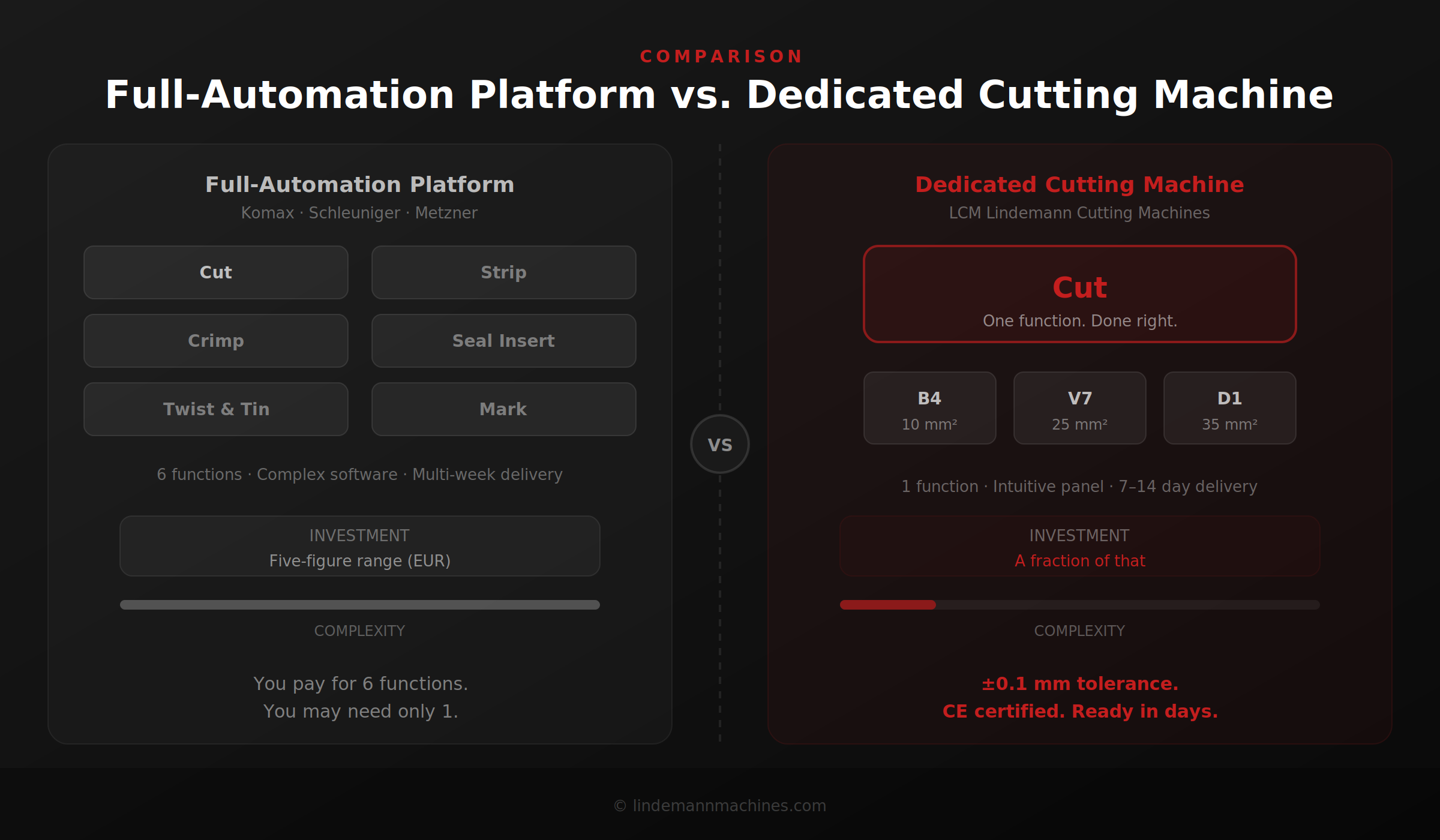
- Komax, Schleuniger, and Metzner build multi-function wire processing machines — cut, strip, crimp, mark, tin. If you only need cutting, you are paying for functions you will never use.
- LCM machines do one thing: precision cable cutting at ±0.1 mm tolerance, with stepper motor drives and guillotine blades.
- Three models cover cross-sections from 10 mm² to 35 mm² — matching the cutting capacity of machines that cost several times more.
- Full CE certification under EU Machinery Directive 2006/42/EC, with declaration of conformity and documentation in English and German.
- Delivery in 7–14 days. No multi-week lead times, no complex installation, no training program needed.
- The investment pays for itself within 3–6 months for most production environments running 500+ cuts per day.
Your production floor runs 800 cable cuts per day. An operator measures, aligns, cuts — manually. Every measurement takes 3 seconds. Every cut introduces a tolerance risk. At the end of the month, you are looking at wasted material, inconsistent lengths, and a bottleneck that slows down everything downstream.
So you search for a solution. Komax comes up. Schleuniger comes up. Metzner comes up. And then you see the scope: fully automatic wire processing platforms that cut, strip insulation, crimp terminals, insert seals, twist strands, tin ends, and print markings — all in one machine. The investment runs into five figures. The lead time stretches into weeks. The training manual is thicker than your production log.
But here is the question nobody asks early enough: do you actually need all of that?
If your process requires only cutting — precise, repeatable, fast cutting of cables and wires to length — you do not need a multi-function platform. You need a dedicated cable cutting machine. That is exactly what LCM builds.
What Komax, Schleuniger, and Metzner Actually Build
There is nothing wrong with Komax machines. The Alpha 530, for example, is an impressive piece of engineering: fully automatic crimping, seal insertion on both sides, strand twisting, tinning, inkjet marking — all in one platform, processing wire cross-sections from 0.13 to 6 mm². Schleuniger and Metzner offer similar multi-station systems with modular process capabilities.
These machines are designed for high-volume automotive harness production, where every wire needs stripping, crimping, seal loading, and marking before it leaves the machine. If that is your process — those are the right tools.
But most small and mid-size cable processing companies do not run automotive harness lines. They cut cables to length. That is the core operation. Stripping, crimping, and marking either happen at a separate station or are not needed at all.
| Feature | Komax / Schleuniger / Metzner | LCM Cutter |
|---|---|---|
| Functions | Cut, strip, crimp, mark, tin, seal insert | Cut only |
| Cutting tolerance | ±(0.2% + 1 mm) typical | ±0.1 mm |
| Max. cross-section (cutting) | 0.13–6 mm² typical (up to 95 mm² heavy-duty models) | Up to 35 mm² (CUTTER D1) |
| Drive system | Servo motors, EtherCAT | Stepper motor, guillotine blades |
| Setup / changeover | Software-based, multi-parameter | Manual, under 90 seconds |
| Training required | Extensive (software + modules) | Minimal — intuitive panel |
| CE certification | Yes | Yes — full EU compliance |
| Investment level | Five-figure range (EUR) | A fraction of that — request a quote → |
| Delivery | Weeks to months | 7–14 days |
The table makes one thing clear: these are different categories of equipment, built for different production realities. Comparing them directly would be like comparing a CNC machining center with a precision bandsaw — both cut metal, but you would not buy a CNC center to make straight cuts all day.
When a Komax Alternative Makes Sense
You are overpaying for automation if:
- Your process is cutting cables or wires to length — and stripping, crimping, or marking happens at a separate station or not at all.
- Your daily volume is 500–5,000 cuts — enough to justify automation, but not enough to justify a fully automatic wire processing machine.
- You process flexible conductors, PVC-insulated wire, rubber cables, silicone tubing, or similar materials that only need a clean, precise cut.
- Your team does not have the capacity to learn and maintain a complex software-controlled multi-station platform.
- You need the machine running within days, not after a multi-week installation and commissioning process.
This is the gap LCM fills. Not as a competitor to Komax — but as an alternative for production environments where full automation is overkill and manual cutting is no longer viable. For a detailed look at how much manual cutting actually costs — and how quickly a machine pays for itself — see our buyer’s guide with ROI calculator.
Three Models, One Focus: Precision Cable Cutting
Every LCM machine is built around the same principle: stepper motor-driven wire feed, guillotine cutting blades, and a simple control panel with adjustable pressure rollers calibrated to the wire’s cross-section. No software suites. No network integration. No process modules. Just reliable, repeatable cutting.
Entry-level · Bestseller
- Max. cross-section: 10 mm² (16 mm² on request)
- Tolerance: ±0.1 mm
- Ideal for: standard cables, thin conductors, tubing
Mid-range
- Max. cross-section: 25 mm²
- Tolerance: ±0.1 mm
- Ideal for: thicker power cables, multi-core wires
Heavy-duty
- Max. cross-section: 35 mm²
- Tolerance: ±0.1 mm
- Ideal for: heavy-gauge cables, industrial wiring, photovoltaic cables
All three models share the same core: CE-certified, stepper motor drives, guillotine blades, adjustable pressure rollers, and a control panel that any operator can learn in under 30 minutes. Blade replacement is straightforward — no technician visit required. First-year service is included.
Not sure which model fits your cable diameter?
Send us a sample of your cable material — we will run a free test cut and recommend the right machine for your process.
CE Certified: Full EU Compliance, Not a Grey Import
One legitimate concern when looking at alternatives to established brands: does the machine actually comply with EU safety regulations?
Every LCM machine ships with full CE marking under the EU Machinery Directive 2006/42/EC. That means a complete risk assessment, declaration of conformity, and technical documentation — the same regulatory framework that Komax and Schleuniger comply with. The directive ensures that any machine placed on the EU market meets essential health and safety requirements for mechanical and electrical safety, as defined in Annex I of the directive.
„CE marking is the only marking which guarantees that machinery conforms to the requirements of the Machinery Directive.”
— EU Machinery Directive 2006/42/EC, Recital 19
LCM also provides operating manuals in English and German. This is not a cosmetic detail — it is a legal requirement for placing machinery on the EU market, and it is something many low-cost alternatives from outside the EU skip entirely.
Note: the Machinery Directive 2006/42/EC will be replaced by Regulation (EU) 2023/1230, effective from January 2027. LCM is already tracking the new requirements for continued compliance.
Changeover in 90 Seconds, Not 90 Minutes
What simplicity looks like in practice:
- Changeover: Switch from one cable type to another in under 90 seconds — adjust the pressure roller, set the length on the panel, start cutting.
- No software: No HMI screens, no TopWin, no EtherCAT network. The control panel has physical buttons: SET, CUT, FEED, START, STOP, RESET.
- No prefeeder required: Wire feeds directly into the machine. No coil unwinder, no belt-driven prefeeder system needed for standard operations.
- Blade replacement: Guillotine blades are user-replaceable. No service visit, no calibration software. Replace, recalibrate the roller, continue.
- Footprint: Benchtop machine. No floor space allocation, no compressed air line, no dedicated electrical panel.
Complexity has a hidden cost: every additional module adds a failure point. Every software layer adds a dependency. Every training requirement adds time before the machine is productive. For operations where the task is cutting — and only cutting — simplicity is not a limitation. It is a design choice that eliminates downtime and reduces total cost of ownership. The same machine also handles heat shrink tubing and flexible sleeving — without tool changes or reconfiguration.
Wire Cross-Section Reference: mm² to AWG
If you are sourcing from or selling to US or UK markets, cross-sections are often specified in AWG (American Wire Gauge) rather than mm². Here is how LCM’s cutting capacity maps to AWG:
| LCM Model | Max. mm² | Approx. AWG | Approx. Diameter |
|---|---|---|---|
| CUTTER B4 | 10 mm² (16 on req.) | 8 AWG (6 on req.) | ~4.1 mm (conductor) |
| CUTTER V7 | 25 mm² | 4 AWG | ~6.5 mm (conductor) |
| CUTTER D1 | 35 mm² | 2 AWG | ~7.9 mm (conductor) |
All models handle PVC, rubber, silicone, cross-linked (SXL/GXL), and Teflon-insulated wire. For materials with unusual hardness or outer diameter beyond standard specs, send a sample — LCM runs free feasibility tests before purchase.
The Real Question: What Does Your Process Actually Require?
Most companies searching for a Komax alternative are not looking to replicate Komax capabilities at a lower price. They are looking for something fundamentally different: a machine that solves one specific problem — cutting cables to precise, repeatable lengths — without the complexity, cost, and overhead of a multi-function wire processing platform.
If your process requires stripping, crimping, seal insertion, or wire marking as part of an integrated automated line — Komax, Schleuniger, and Metzner are the right tools. No argument there.
If your process requires cutting — and cutting is the bottleneck, the error source, or the manual labor drain — an LCM machine does that job at ±0.1 mm, with CE certification, fast delivery, and an investment that pays for itself within months.
Summary: Why LCM as a Komax Alternative
- Focused machine, focused price. LCM builds dedicated cable cutting machines — not multi-function platforms. The investment reflects that focus.
- ±0.1 mm cutting precision. Stepper motor drives and guillotine blades deliver consistent, repeatable cuts across all three models.
- Three models: 10, 25, 35 mm² max cross-section. From thin control cables (B4) to heavy-gauge power cables (D1).
- Full CE compliance. Declaration of conformity, risk assessment, English and German manuals — ready for the EU market.
- 90-second changeover. No software reconfiguration. Adjust the roller, set the length, start cutting.
- 7–14 day delivery. Machines are production-ready and ship within two weeks.
- ROI in 3–6 months. Reduced material waste, eliminated measurement errors, freed-up operator time.
Ready to see what LCM can do with your cable?
Send us your cable material — we will run a free test cut and send you the results with a recommendation.
No obligation. No sales pitch. Just data.
Or call directly: +48 571 505 807
Sources
- Verified Market Reports, Automatic Wire Processing Machine Market Size, Share & Forecast 2030 — market size and growth data.
- EU-OSHA, Directive 2006/42/EC — Machinery Directive — CE marking and safety requirements.
- Komax Group, Alpha 530 Product Page — specifications and capabilities of a representative full-automation platform.
FAQ
Is LCM a direct competitor to Komax?
No. Komax builds fully automatic wire processing machines that cut, strip, crimp, mark, and tin in one platform. LCM builds dedicated cable cutting machines — cutting only. If your process requires only precise cutting to length, LCM is a more economical and focused alternative. If you need stripping, crimping, or marking integrated into one machine, Komax or Schleuniger are the better fit.
What is the cutting tolerance of LCM machines?
All three LCM models — CUTTER B4, V7, and D1 — deliver a cutting tolerance of ±0.1 mm. This is achieved through stepper motor-driven wire feed and guillotine cutting blades, with an adjustable pressure roller calibrated to the cable’s cross-section.
Are LCM machines CE certified?
Yes. Every LCM machine ships with full CE marking under the EU Machinery Directive 2006/42/EC. This includes a declaration of conformity, risk assessment documentation, and operating manuals in English and German. The machines comply with all essential health and safety requirements for mechanical and electrical safety as defined in Annex I of the directive.
What materials can LCM machines cut?
LCM machines handle PVC-insulated wire, rubber cables, silicone tubing, cross-linked insulation (SXL, GXL), and Teflon-insulated conductors. Maximum cross-section depends on the model: 10 mm² for CUTTER B4, 25 mm² for CUTTER V7, and 35 mm² for CUTTER D1. For unusual or very hard materials, LCM offers a free feasibility test before purchase.
How long does delivery take?
Standard delivery is 7–14 days from order confirmation. Machines ship production-ready — no on-site installation or commissioning needed. First-year service is included in the purchase.