
Automatic Wire Cutting Machine for Production — What to Look for Before You Buy
- An automatic wire cutting machine eliminates length errors, material waste, and operator fatigue — even in batches as small as 50 pieces.
- Entry-level machines with stepper motor drives deliver ±0.1 mm precision on cables up to 35 mm² — at a fraction of the cost of full-line systems.
- The five criteria that matter most: maximum cross-section, cutting precision, drive type, program memory, and after-sales service.
- At just a few hours of manual cutting per day, a machine typically pays for itself in under 2 months.
- Full-line systems (Komax, Schleuniger) make sense above 10,000 pieces/day — but require a five-figure investment. Below that, a dedicated cutting machine is the more efficient choice.
- Cheap machines with DC motors and plastic rollers often lose precision after 3–6 months. Stepper motors and metal rollers hold tolerance long-term.
If your operators spend hours each day measuring and cutting cables by hand, you already know the problem: inconsistent lengths, wasted material, and people tied up in repetitive work instead of assembly or processing. An automatic wire cutting machine solves all three — but the market ranges from cheap desktop gadgets to five-figure full-line systems. This guide helps you find the right machine for small and mid-size production, without overspending or underbuying.
Why an automatic cutter pays off — even in small production
Manual cable cutting looks cheap on paper. A pair of side cutters costs next to nothing. But the real cost is hidden in three places most production managers never calculate.
| Criterion | Hand tools | Entry-level automatic machine | Full automation line |
|---|---|---|---|
| Typical investment | Minimal | Affordable — request a quote | Five-figure investment |
| Precision | ±2–5 mm (operator dependent) | ±0.1 mm (stepper motor) | ±0.1 mm or better |
| Output | ~60–120 pcs/h | 2,000–5,000 pcs/h | 5,000–15,000+ pcs/h |
| Operator required | Full-time during cutting | Setup only — runs unattended | Monitoring + material loading |
| Functions | Cut only | Cut to length (some: strip) | Cut, strip, crimp, mark, insert |
| Best for | Repairs, prototypes, <20 pcs | 50–5,000 pcs/day, mixed batches | 10,000+ pcs/day, single product |
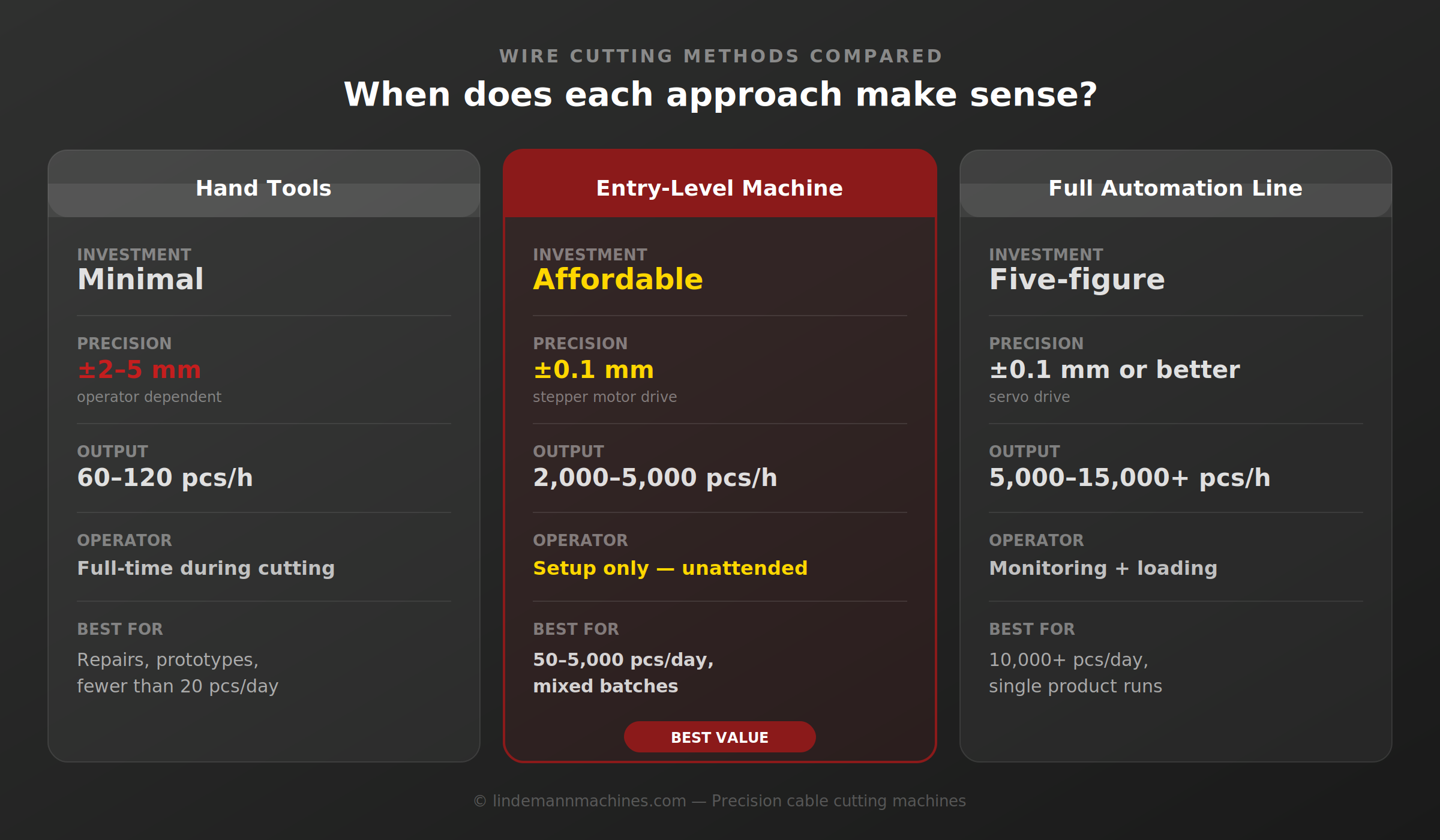
For most small and mid-size cable harness workshops, control panel builders, and electrical assembly companies, the entry-level automatic machine hits the sweet spot. It automates the most time-consuming step — cutting to precise length — without the complexity, cost, and floor space of a full processing line.
5 things to check before buying a wire cutting machine
Not every automatic cutter is built the same. These five criteria separate machines that last from machines that end up gathering dust after six months.
Match the machine to the thickest cable you run. If you process cables up to 10 mm², a smaller machine is fine. If you handle 25–35 mm² power cables, you need a heavier-duty cutter with stronger feed rollers and blades. Over-specifying wastes money; under-specifying damages material.
Stepper motors deliver consistent, repeatable feed lengths — typically ±0.1 mm. DC motors are cheaper but drift over time. For production wire processing, stepper drive is the minimum standard. Servo drives offer even more precision but at a higher price point.
If you cut cables in recurring batches — and most production environments do — you want a machine that stores programs. Set the length and quantity once, recall it for every reorder. Machines with 50–99 program slots eliminate setup time almost entirely for repeat jobs.
Guillotine-style blades produce clean, straight cuts across the full cable diameter. Rotary blades work but can deform softer insulation materials. Check whether replacement blades are readily available and what they cost — this is your main consumable.
A machine is only as good as the support behind it. Can you reach a technician by phone — in your language? Is the first year of service included? Are spare parts shipped from within Europe or from overseas? These questions matter more than the spec sheet when something goes wrong on a Friday afternoon.
Not sure which machine fits your production?
Send us a sample of your cable. We’ll cut it, measure the result, and recommend the right model — no cost, no obligation.
Request a free cutting testCalculate your actual cost of manual cutting
The biggest argument for an automatic wire cutting machine isn’t speed — it’s the labor cost you’re currently burning. Use the calculator below to see what manual cutting costs you per month and how fast a machine pays for itself.
How much does manual cutting cost you?
When the operator cuts cables — they don’t assemble, don’t process, don’t fulfil orders. It’s not just an hourly cost. It’s throughput you won’t recover without a machine.
* Approximate calculation. Cutting output based on average measurements (80 pcs/min at 30 mm). Actual savings depend on material, batch size and workflow. Let’s discuss your case.
What you get with an affordable, dedicated cutting machine
LCM Lindemann Cutting Machines builds three models designed for one thing: precise, repeatable cable cutting in production environments. No stripping, no crimping, no marking — just cutting, done right. This focus keeps the machines simple, reliable, and affordable.
| Specification | CUTTER B4 | CUTTER V7 | CUTTER D1 |
|---|---|---|---|
| Max. cross-section | 10 mm² (16 on request) | 25 mm² | 35 mm² |
| Precision | ±0.1 mm | ||
| Drive | Stepper motor | ||
| Blade type | Guillotine | ||
| Program memory | 99 programs | ||
| Display | 4D System touchscreen | ||
| Interface languages | 6 (incl. English, German) | ||
| Certification | CE, Declaration of Conformity, RoHS | ||
| Delivery | 7–14 days | ||
| Service | First year included. Phone support in EN/DE. | ||
LCM cutters are dedicated cutting machines. They don't strip insulation, crimp terminals, or mark cables. If your wire processing workflow requires stripping or crimping, you'll need separate equipment for those steps — or a full cut-strip-crimp line from brands like Komax or Schleuniger (a significantly larger investment). For a detailed comparison of what you get with an LCM machine vs. a full-line system, see our Komax alternative guide. For many workshops, a dedicated cutter handles 80% of the bottleneck at a fraction of the cost.
Cheap wire cutting machines — what to watch out for
Search for "automatic wire cutter" on any marketplace and you'll find machines for a few hundred euros. They look similar to professional equipment in photos. The differences show up after a few months of daily use.
Key takeaways
- Manual cutting costs more than you think. Even a few hours per day of operator time spent cutting adds up to tens of thousands per year — plus material waste and rework from length errors.
- An entry-level automatic wire cutting machine pays for itself within weeks, not months, in most small and mid-size production environments.
- Stepper motor drive is the minimum standard for consistent ±0.1 mm precision. Avoid machines with DC motors for production use.
- Match the machine to your thickest cable. 10 mm² for standard wiring, 25 mm² for mid-range, 35 mm² for power cables.
- A dedicated cutter covers 80% of the bottleneck at a fraction of the cost of a full cut-strip-crimp line.
- Service and spare parts availability matter more than specs on paper. A CE-certified, European-built machine with phone support is worth the premium over unbranded imports.
- Use the ROI calculator above to see the exact payback period for your specific production parameters.
If your production also involves cutting heat shrink tubing, PVC sleeving, or silicone tubes — these same machines handle all of them. See our guide to cutting heat shrink tubing with ±0.1 mm precision for material-specific details.
Sources
- OSHA / Bureau of Labor Statistics, Ergonomics — Musculoskeletal Disorders — roughly one-third of lost-workday cases involve musculoskeletal injuries from repetitive tasks.
- UL Solutions, Minimizing Material Waste in Wire and Cable Manufacturing — managing cut lengths is critical; an odd 20 m leftover on a 500 m order represents ~4% material loss.
- Zuken US, Wire Harness Manufacturing Automation Ideas in a Tight Labor Market — automated wire processing machines can save more than 50% of labor costs.
Frequently asked questions
What materials can an automatic wire cutting machine process?
Most entry-level machines handle PVC-insulated cables, silicone wire, Teflon wire, heat shrink tubing, flat ribbon cable, and flexible tubing. The limiting factor is usually the maximum cross-section (measured in mm² or AWG) and the outer diameter. Always test your specific material before committing — reputable manufacturers offer free cutting tests for this reason.
How fast is an automatic cutter compared to manual cutting?
A skilled operator with side cutters and a measuring tool can cut roughly 60–120 pieces per hour. An automatic machine with stepper motor drive produces 2,000–5,000 pieces per hour depending on cut length — and it runs unattended, freeing the operator for assembly or other tasks.
Do I need a cut-and-strip machine, or is cutting only enough?
It depends on your workflow. If your operators strip after cutting (e.g., at the crimping station), a dedicated cutting machine covers the bottleneck — cutting to length — at a fraction of the cost. If you need both operations in one pass, a combined cut-and-strip machine is more efficient but requires a significantly larger investment.
What's the difference between LCM machines and Komax or Schleuniger?
Komax and Schleuniger build full wire processing platforms — cut, strip, crimp, insert, mark — designed for high-volume automotive and aerospace production. LCM builds dedicated cutting machines for small and mid-size operations that need precise cutting without the full-line investment. The difference is scope: LCM focuses on cutting only, which keeps the machines simple, reliable, and significantly more affordable. If your primary need is cutting to length with ±0.1 mm accuracy, request a quote and compare for yourself.
Ready to stop cutting by hand?
Send us your cable type and batch size. We'll recommend a model, send you a test cut, and quote a price — all within 48 hours.